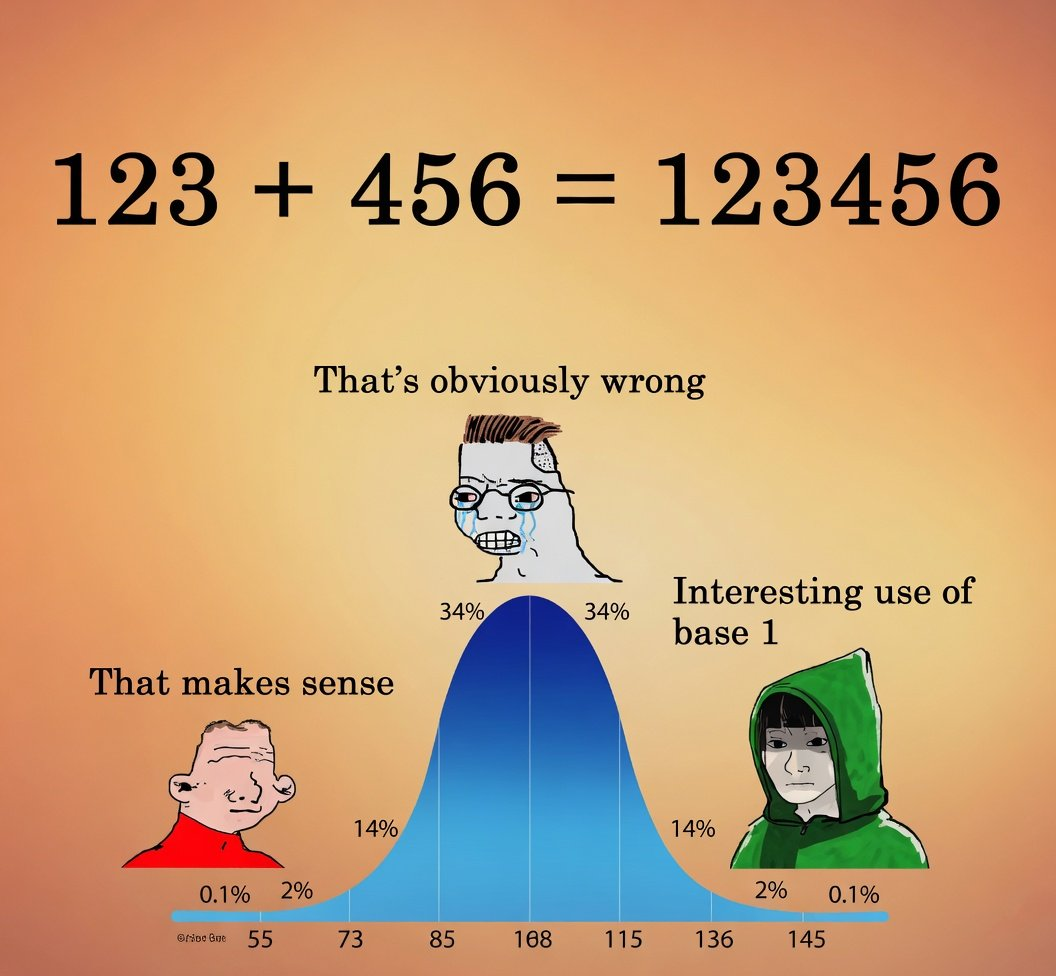

JS devs are like yep, that’s clearly concatenation of 2 strings.
I mean not really cause base one would just be 111 + 111 = 111111. On the other hand if its baseless it still doesnt work cause then its 3 + 6 = 9? But with that it could just be base 10. One thing that could work is that its actually a split base 4 and 8 system where the first 3 digits of a number are base 4 and the rest are base 8 but this is a very confusing system and the opposite of what is usual. It could also be a system where 1, 2, 3 are used for whole parts of numbers and 4, 5, 6 were added when they inveneted fractions so they represent the fractional part of numbers? Thats what im gonna put my money on tho im probably ignoring something obvious.
I disagree with you definition of base 1. Since base 10 is 0 through 9, and base 2 is 0 and 1, therefor base 1 must be only 0.
The real question is: How do we continue?
What is base 0?
Is that equal to base 1?
Are the negative bases?Base 1 is just run length encoding.
1: 1 2: 11 3: 111 ... 10: 1111111111That would be reverse run length encoding. Also, Base 1 is just zero, everything equals zero.
123 = 000 = 0
456 = 000 = 0
123456 = 000000 = 0
123 + 456 = 123456
0 + 0 = 0
69 + 420 = 42069
Base-n is a numeral positioning system where the value of each digit is n times the value of the dight directly to its right.
We typically don’t let the maximum digit we use to be greater than or equal to n because then there would be multiple ways to express the same number.
However when working with weird bases, sometimes it’s useful to forgo this convention.
Being in “this is obviously wrong” category, I have no choice but to downvote this.